

Search has entered a new phase. Search engine optimization (SEO) remains the proven foundation: optimizing websites through content, links, and technical health to win visibility in search engines. Generative engine optimization (GEO) is the new layer, born out of AI-driven search results in tools like Google SGE, ChatGPT, and Gemini. Businesses are now asking: how do the two compare, and which approach fits their goals?
This article breaks down SEO and GEO side by side, showing what makes them different, where they overlap, and how brands can stay visible in generative engines and search engines alike in 2026.
What is SEO?
SEO is the practice of improving a website’s visibility in search results. It relies on three pillars: on-page optimization (content, structure, metadata), off-page signals (backlinks, mentions, authority), and technical health (crawlability, site speed, mobile readiness).
For more than two decades, SEO has been the default model for organic growth online. It’s how businesses have traditionally driven traffic – by ranking higher in Google’s familiar “10 blue links.” It remains the go-to organic approach for online visibility, built on clear signals that help search engines match content with user intent.
What is GEO?
GEO focuses on visibility inside AI-driven search results. Instead of ranking web pages, GEO is about being selected and cited in AI-generated answers across platforms like Google’s Search Generative Experience, ChatGPT, and Gemini.
GEO is newer, shaped by the rise of generative AI 2023 onwards.
It depends on semantic content, entity coverage, topical authority, and E-E-A-T (Experience, Expertise, Authoritativeness, and Trust) signals that convince AI platforms to trust and surface your brand. Unlike SEO, GEO is less about keywords and links, and more about how AI interprets and blends your content.
These platforms often use the RAG model (retrieval-augmented generation): they retrieve content from credible sources and generate answers from it. GEO is the discipline of making sure your brand is one of those sources.
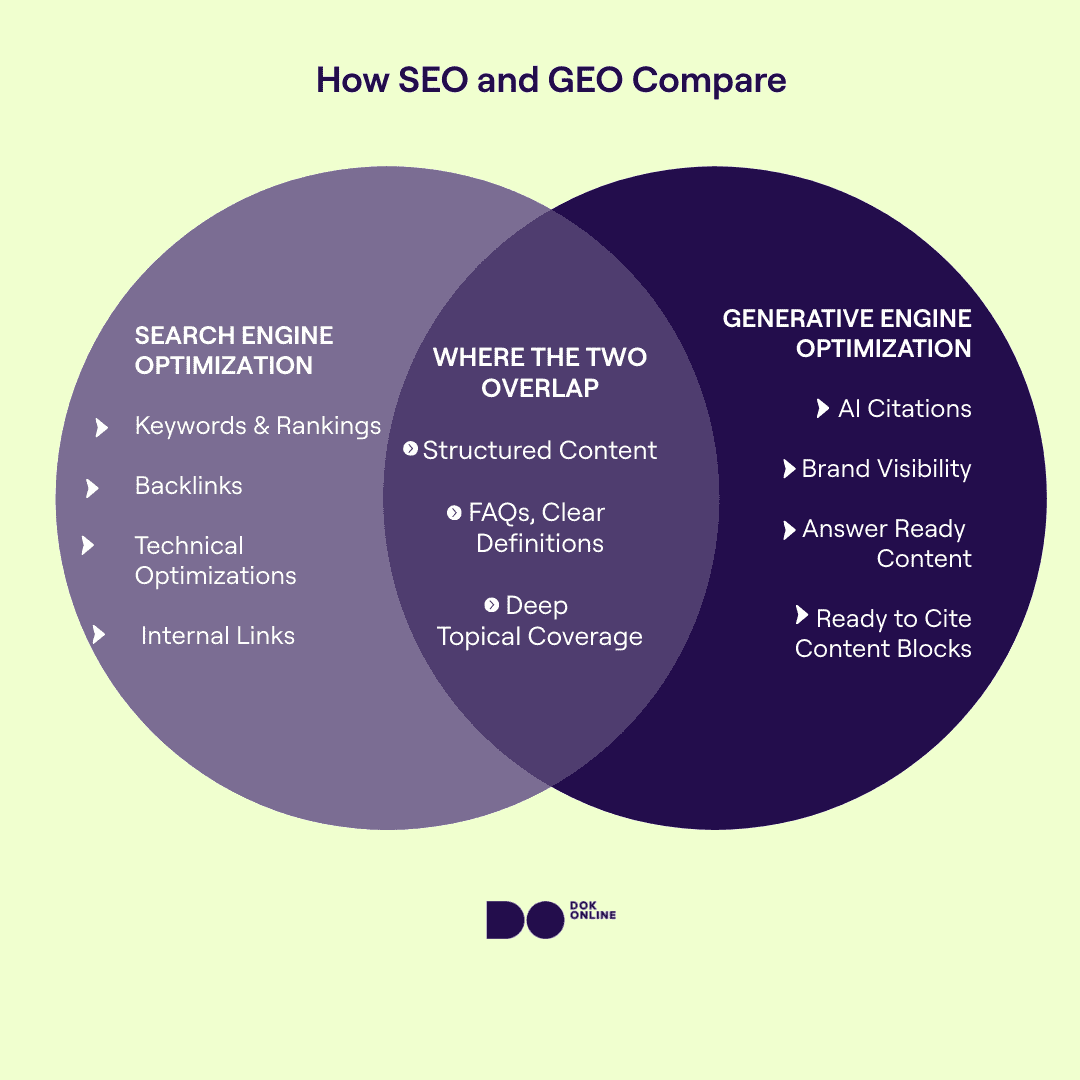
What are the differences between SEO and GEO?
SEO and GEO share the same goal of visibility, but they work a bit differently. SEO optimizes for traditional search engines, while GEO positions content to be retrieved and cited by AI generated responses. The contrast comes down to signals, metrics, and how content is structured.
| Aspect | SEO | GEO |
| Primary signals | Keywords, backlinks, on-page optimization | Entities, vector embeddings, brand mentions, topical authority |
| Technical | Crawlability, sitemaps, mobile-friendly pages | Structured data, semantic consistency, passage clarity |
| Metrics | Rankings, clicks, impressions, CTR | Citations in AI answers, AI summaries, Brand mentions, visibility in SGE, backlinks (indirect) |
| Content style | Keyword-targeted, SERP-oriented copy | Answer-first, snippet-ready, semantically rich |
| User intent | Transactional, navigational, informational | Conversational, complex, multi-step tasks |
| Stability | Algorithm updates (predictable cycles) | AI parsing (volatile, frequent model updates) |
| Off-page signals | Backlinks, domain authority | Brand mentions & citations, E-E-A-T signals, brand identity |
Signals and ranking factors
SEO has always relied on manual keyword research, backlinks, and technical health to decide who ranks. GEO, in contrast, works on entities, branding, embeddings, and semantic coverage. It’s less about exact keyword matches and more about how well your brand fits into a topic landscape.
For example, SEO would focus on targeting keywords like running shoes. AI driven search engines, however, look at related entities and how the brand is positioned across them. For an ecommerce site, this can include brand names (Nike), product lines (Pegasus), features (cushioning), and contexts (marathon training). AI algorithms weigh these connections and favor sources that demonstrate topical authority and brand credibility across all these entities.
Metrics of success
In SEO, success is measured through rankings, impressions, clicks, and CTR – metrics tied to position on traditional search engine results pages. Tools like Google Search Console and Ahrefs make performance tracking straightforward.
GEO doesn’t work with rank positions. Instead, success means your brand or content is cited inside AI-generated answers – whether in Google SGE, ChatGPT, or Gemini. These mentions are harder to track and often require manual review or screenshot-based monitoring. Visibility in GEO is measured indirectly – in terms of whether your content is chosen by the model as a trusted source.
Optimization focus
SEO optimization revolves around controlling how your page appears in Google’s “10 blue links.” Factors like title tags, meta descriptions, headings, and structured data all play a role. Keyword research is often a big part of this too.
GEO, on the other hand, is about making your content easy for AI to extract, interpret, and reuse. That means crafting clean, semantically structured passages, using question-and-answer formats, and reinforcing context. You are writing for the people, but designing it for the machines. Technical site optimization elements like crawlability, schema, loading speed, etc., become all the more important in GEO.
Want your brand cited in ChatGPT, Gemini, or other AI LLM engines?
Let’s map your GEO strategy and turn your content into a source AI models trust.
Key similarities between SEO and GEO: How do the two work together?
Despite their differences, SEO and GEO share foundational goals. Both aim to satisfy the searcher, reward high-quality content, and surface trustworthy sources.
While the mechanics differ, the strategic pillars are aligned. Businesses that build for SEO often strengthen the GEO. This is because search engines and AI systems are ultimately after the same thing: relevant, reliable information. If anything, AI systems often retrieve their answers from the top-ranking pages.
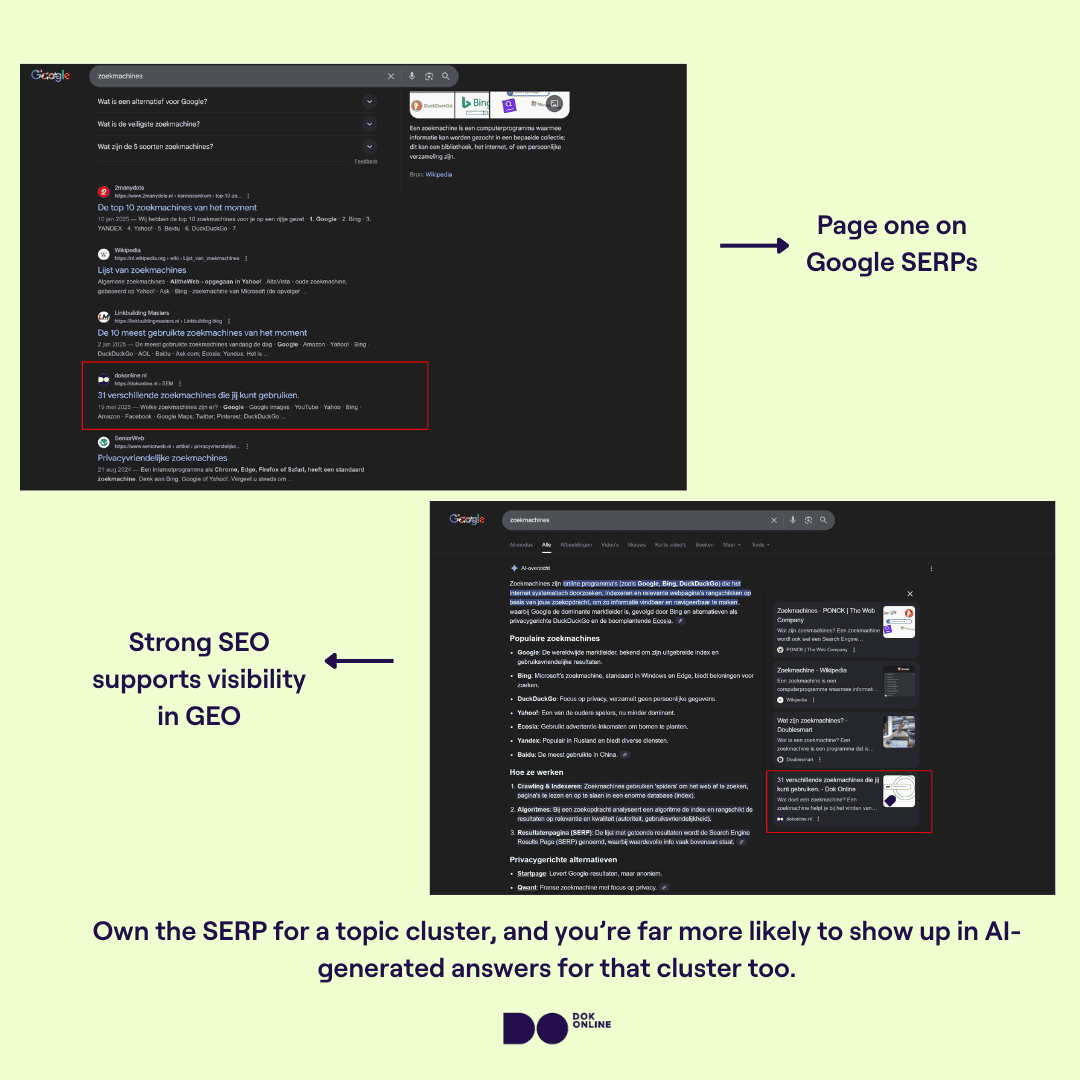
As one of top seo agencies specializing in GEO, we are seeing this first hand. Brands built on strong SEO foundations are finding it easier to navigate the new era of AI search visibility than the ones that are not.
| Shared element | Why it matters |
| Quality content | Both reward clarity, accuracy, and depth |
| Topical authority | Covering entities and clusters improves visibility |
| User intent | Satisfying the searcher’s need remains central |
| Brand credibility | E-E-A-T signals matter in both models |
| Technical foundations | Clean structure, speed, and accessibility help both |
| Continuous updates | Both require fresh, updated content |
High-quality content
Content is king: this was true before and will remain true in the future.
Neither SEO nor GEO tolerates shallow, generic content. In both systems, writing high-quality SEO copies means being clear, accurate, well-structured, and useful. Thin pages stuffed with keywords might have worked years ago, but not in 2025. Whether you’re optimizing for SERPs or AI snapshots, content that educates and engages will always rise to the top.
AI models and search engines alike reward well-written, semantically rich copy that explains topics in full and anticipates related questions. The trick is to split the content smartly – build pillars-&-cluster pages and internally link them strategically so machines understand the hierarchy of your content.
Topical and entity authority
In both SEO and GEO, success comes from owning topics. While ranking keywords is one part of it, true, long-lasting visibility comes from covering the topic in all its completeness. This means building deep content clusters that cover all related concepts: categories, features, explainers, comparisons, reviews, case studies, service/product pages, thought leadership, etc.
This is commonly referred to as topical authority, and it is an important part of staying visible.
Where SEO once focused on things like keyword density and volume of pages, GEO requires semantic depth and context. AI systems need to see that your site understands a topic clearly & systematically in its full scope. Businesses that invest in this level of content build authority that translates across both classic search and AI-driven systems.
Brand credibility and trust
Google and AI engines both value trustworthy sources. In SEO, this shows through domain authority, author bios, backlinks, and citations. In GEO, it shows through mentions, reviews, expert associations, and identity clarity. If your brand is cited in trusted articles, reviewed on respected platforms, or linked to in industry press, that credibility easily transfers across AI search engines.
For example, if your SaaS product already has strong visibility on G2, Capterra, Reddit, or industry blogs, platforms like ChatGPT, Gemini, and SGE are more likely to surface your name when generating answers. They draw from these live and authoritative sources.
In short: if you’re already doing the right things off-page, GEO becomes a natural extension.
Why is GEO harder to control: Common challenges
GEO is harder to control because it depends on systems you don’t directly influence. AI systems choose what to cite based on dynamic signals like trust, structure, and freshness. Unlike SEO, which evolves through visible rules and tools, GEO operates behind the scenes with far less transparency.
This makes it difficult to predict, measure, or manage. Even when your content is strong, you’re not guaranteed inclusion in AI answers unless your brand is already credible, your content is structured correctly, and your visibility is consistent across the web.
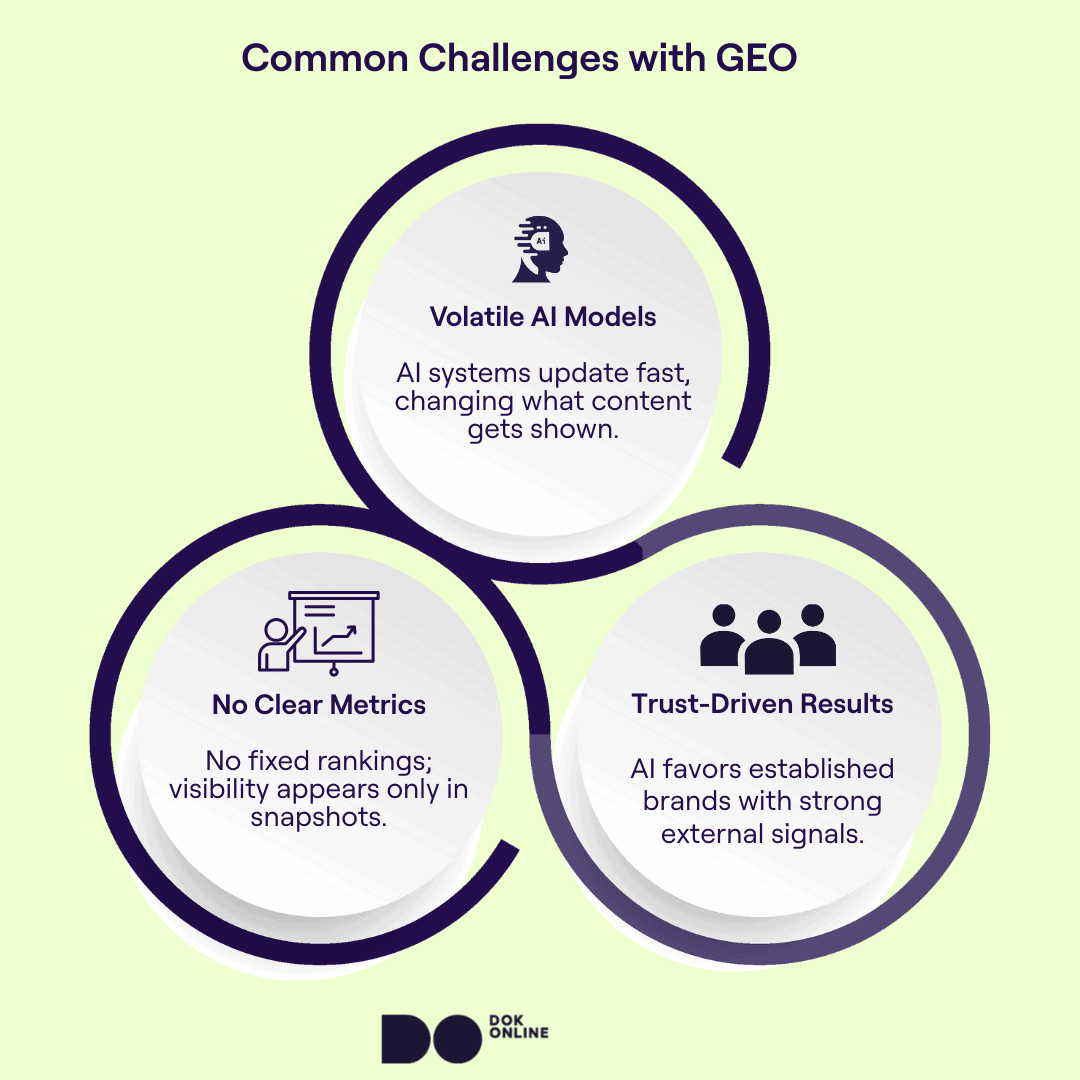
Here are three reasons GEO presents new challenges for businesses trying to appear in AI-driven search engines:
Volatility in AI parsing
GEO is volatile because AI models change constantly – and so does what they surface. Tools like ChatGPT, Gemini, Gork, and SGE are updated frequently with new data and shifting model weights, which means visibility is never guaranteed. The stories of massive drop in quality between ChatGPT 4 vs. 5 illustrate this point clearly.
ChatGPT may cite your blog one week and ignore it the next. That can happen because a new, better-structured source entered its training set, your page layout changed, or the model’s internal parameters for source selection were updated.
Visibility often hinges on how structured, accessible, and indexable your content is at the time the model is trained or queried. If those factors aren’t aligned, your brand is left out – no matter how good the content is.
Difficulty of measurement
GEO is hard to measure because it doesn’t produce fixed rankings, positions, or click data. There’s no dashboard to tell you when your brand appears in ChatGPT, Gemini, or SGE – at the time of writing.
Instead, visibility shows up in fleeting AI-generated snapshots. Some teams track this by capturing screenshots, testing prompts manually, or using tools that simulate AI queries. But it remains inconsistent – simply because these are still very early days.
Without standard metrics, most businesses don’t even know if they’re cited – making it difficult to prove ROI or guide strategy without hands-on monitoring.
Heavy reliance on authority signals
GEO relies heavily on authority signals – more than many realize. AI generated responses look for brands and authors they can trust, based on mentions across relevant external platforms, reviews, expert associations, and publication history. This also connects to the broader element of brand building, where the more visible your brand is across trusted sites, the better it is for you.
If your brand isn’t already recognized in the broader web – through articles, citations, or visibility in communities like Reddit – your content is less likely to be surfaced.
SEO vs GEO vs AEO: How do they compare?
Alongside SEO and GEO, a third term has entered the landscape: AEO (Answer Engine Optimization). While GEO focuses on AI-generated results in tools like ChatGPT and Gemini, AEO is about preparing content for direct answers in generated results like featured snippets, voice assistants, and search box answers.
All three aim to control visibility – just in different ways. SEO focuses on traditional SERPs, GEO on generative search, and AEO on answer formatting. Understanding these distinctions helps brands optimize across the entire discovery funnel.
| Aspect | SEO | GEO | AEO |
| Focus | Ranking in SERPs | Being cited in AI-generated answers | Optimizing for direct answers in answer engines (e.g. voice assistants, featured snippets) |
| Primary signals | Keywords, backlinks, technical SEO | Entities, embeddings, brand authority | Structured answers, FAQs, voice-friendly formatting |
| Metrics | Rankings, clicks, traffic | AI citations, mentions, visibility in SGE | Direct answer placement, voice search performance |
| Use cases | E-commerce, SaaS, lead-gen | AI-driven discovery, generative search | Quick factual queries, local queries, voice assistants |
GEO and AEO overlap in many ways – both reward clear, structured content designed to be pulled directly into an answer. But the endpoints differ: AEO is built around short-form, factual queries and schema markup, while GEO is shaped by LLMs that pull from entire knowledge spaces.
When content is well-structured, aligned with entities, and tied to a credible brand, it gains ground in all three models. Businesses that optimize across SEO, GEO, and AEO build future-proof visibility – no matter where or how people search.
When Should Brands Use SEO, GEO, or AEO?
Brands should use SEO for discoverability in traditional search results, GEO to appear in AI-generated answers across platforms like SGE or ChatGPT, and AEO when targeting quick answers or voice-driven queries. That said, if your SEO foundations are strong, you will find it much easier to optimize for generative engines.
Companies will always benefit by combining all three, aligning content strategy with user behavior across every layer of search.
The best SEO–GEO targeting strategies often reflect a mix of approaches that include structured content with strong trust signals for AI models, keyword & topical coverage for traditional SERPs, and clear, concise answers optimized for snippets and voice. This is also what we have seen first-hand an SEO agency too – companies with a strong SEO game will end up doing well in GEO – provided they get the fundamentals right.
Why businesses need both: Integrating SEO and GEO
GEO is the step after SEO. Unless your site is performing well in the search results, it will be next to impossible for it to appear within AI overviews. You optimize for SEO and GEO will naturally follow.
At the end of the day, they are two sides of the same coin – which is visibility in a world where humans search and machines decide.Both require good content, authority, trust, and technical soundness.
Businesses that operate on one front risk being invisible on the other. Dominance in modern search requires presence across both. The combination builds sustainable visibility in every format users rely on to find information and make decisions.
The Dok Online touch
Dok Online builds for where search is going. Our approach aligns semantic structure, technical strength, and topical authority for visibility in both search: engines and AI models. We map the relationships between your content, your industry, and your brand, and turn that into structured strategies that earn recognition, AI citations, and clicks.
Be everywhere your audience searches.
From traditional SEO to AI-driven results, we’ll help your brand appear where people are searching.