

How Notbranded won non-branded jewellery search

Client

Notbranded

Market

E-commerce

meet our Expert
Profielfoto Eline War, ecommerce seo strateeg
Eline War
Ecommerce specialist

How Notbranded won non-branded jewellery search

Executive summary

Notbranded partnered with Dok Online to grow organic visibility beyond their existing audience. The brand was already well-known in the Netherlands, but organic traffic was almost entirely branded: people searching for Notbranded by name. We built a systematic content architecture across their Shopify store, executed a category-level topical map, and shipped SEO-optimised copy for 80+ collection pages across earrings, necklaces, bracelets, and rings. The result was a roughly 10x increase in non-branded organic visitors within three months, with competitive category keywords now ranking in the top five and driving consistent discovery traffic for the first time.
Results

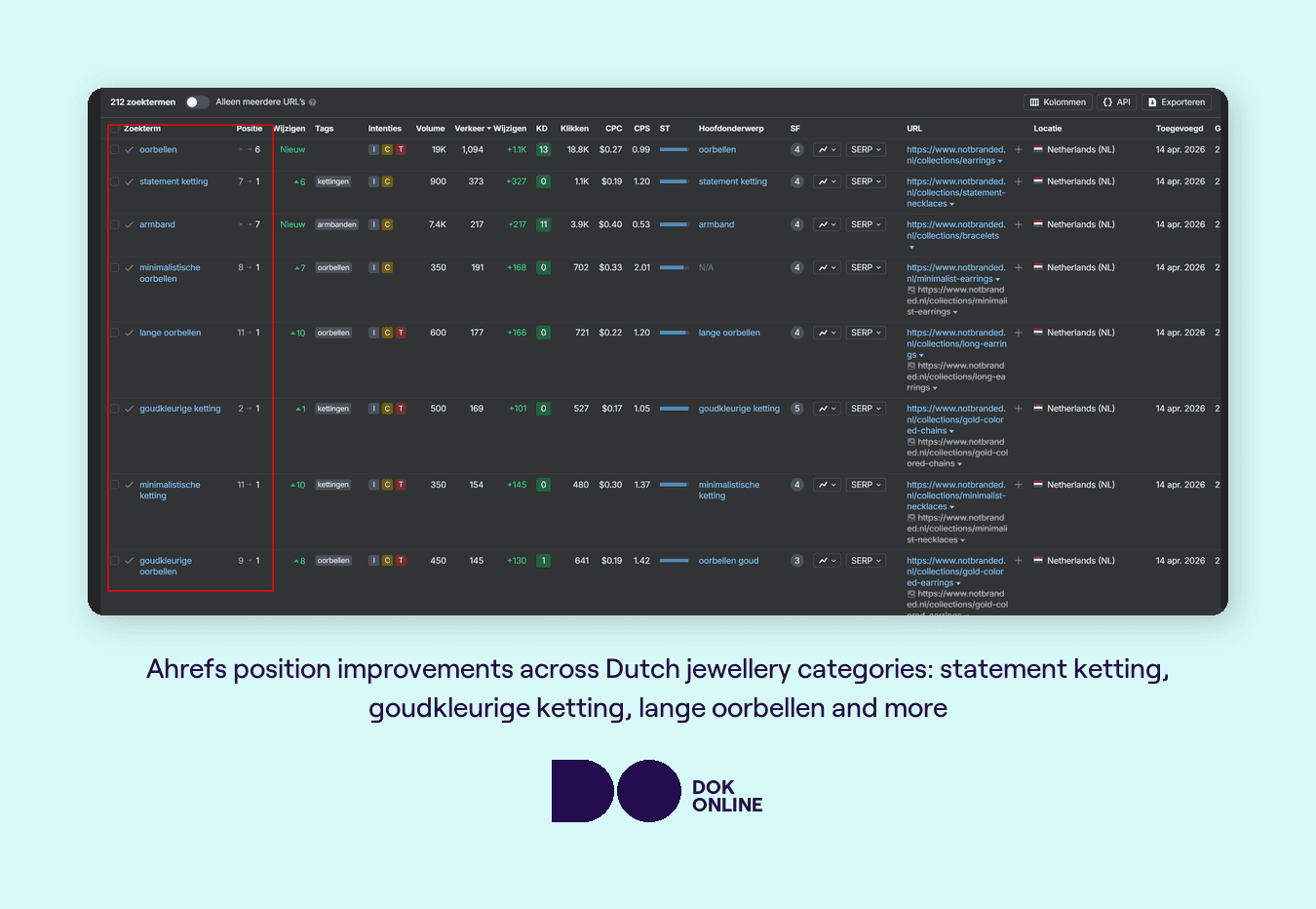
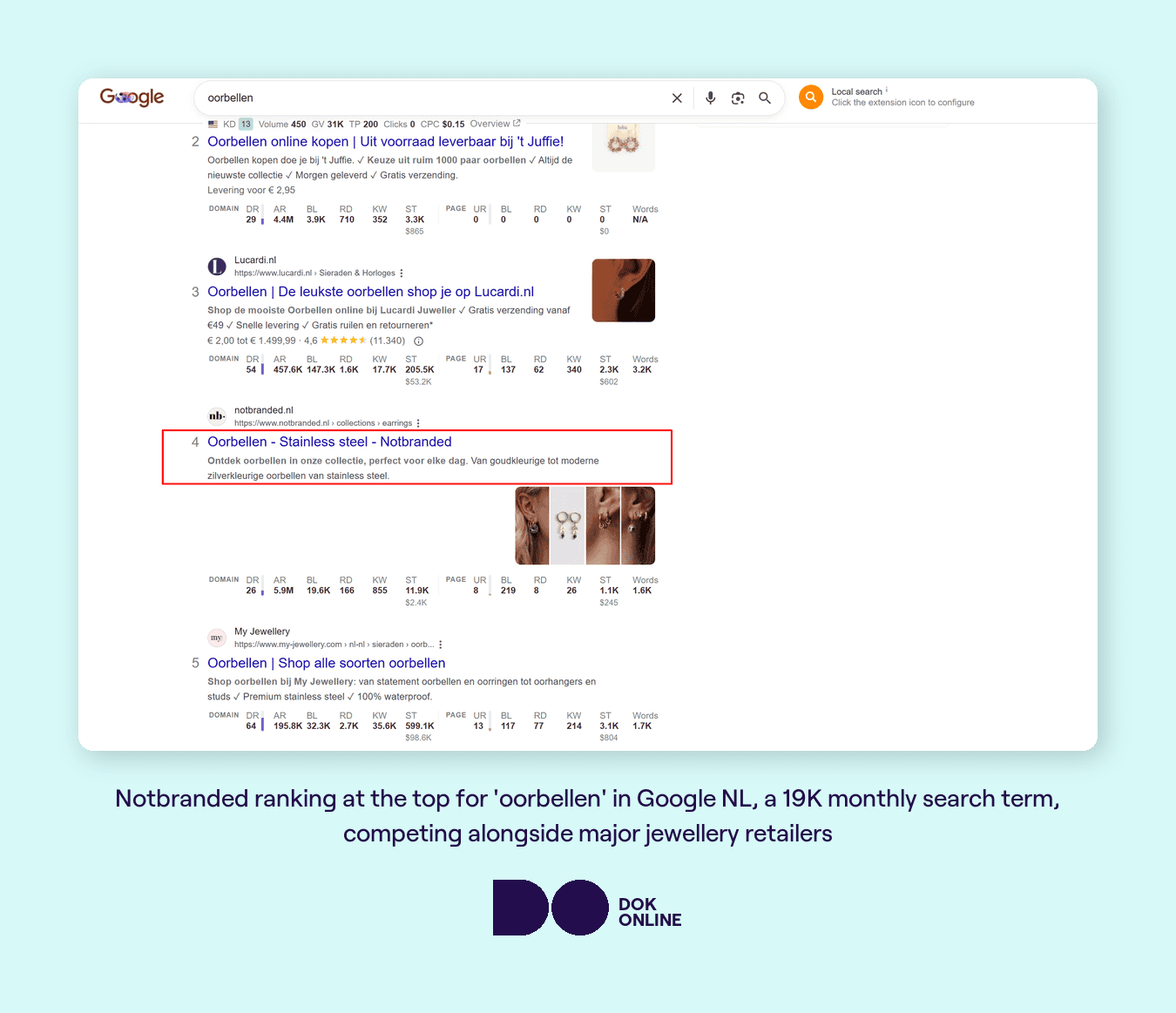
  • ~10x growth in non-branded organic visibility within three months.
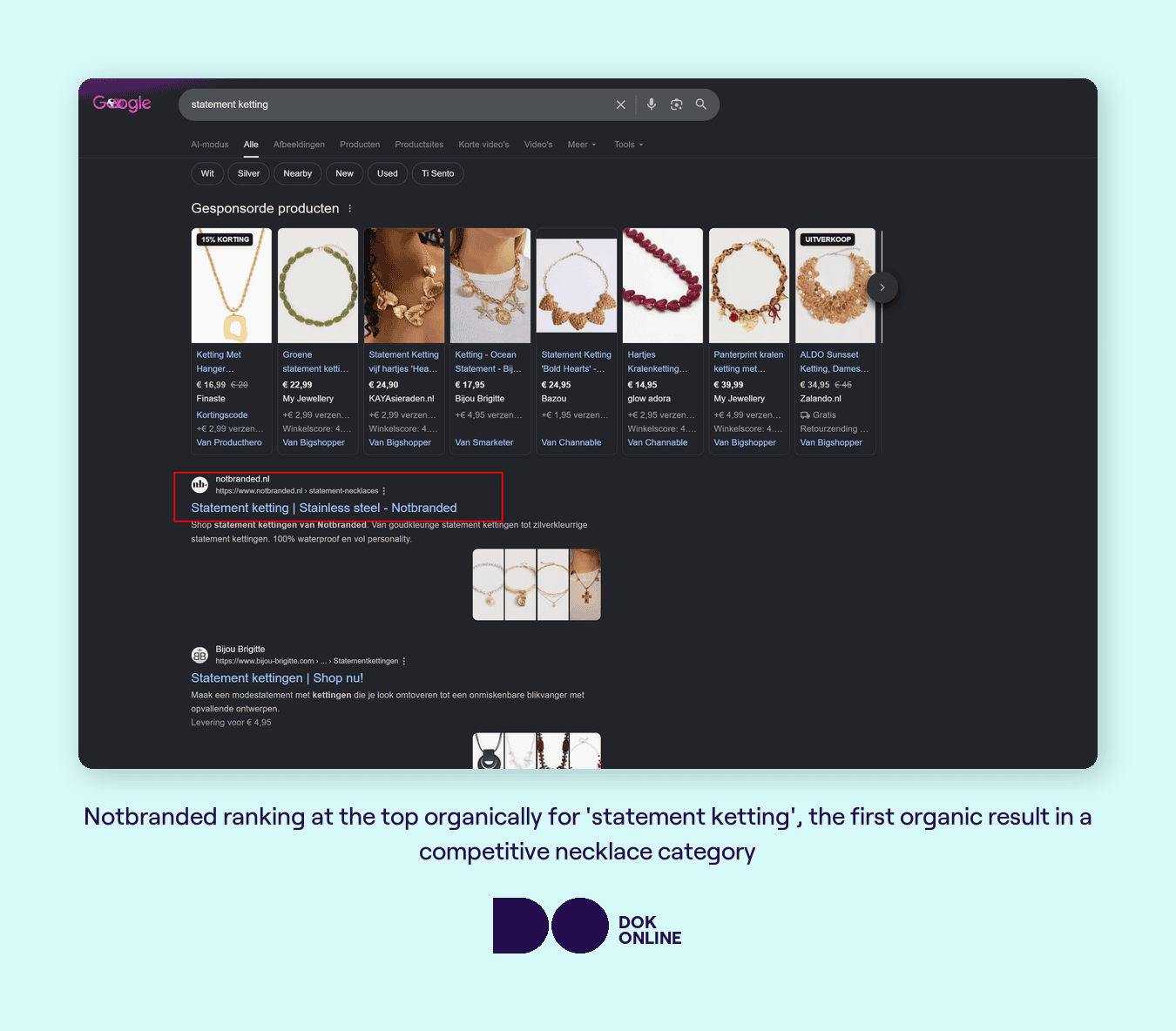
  • “Statement ketting” ranking in the top 5 in Google NL.
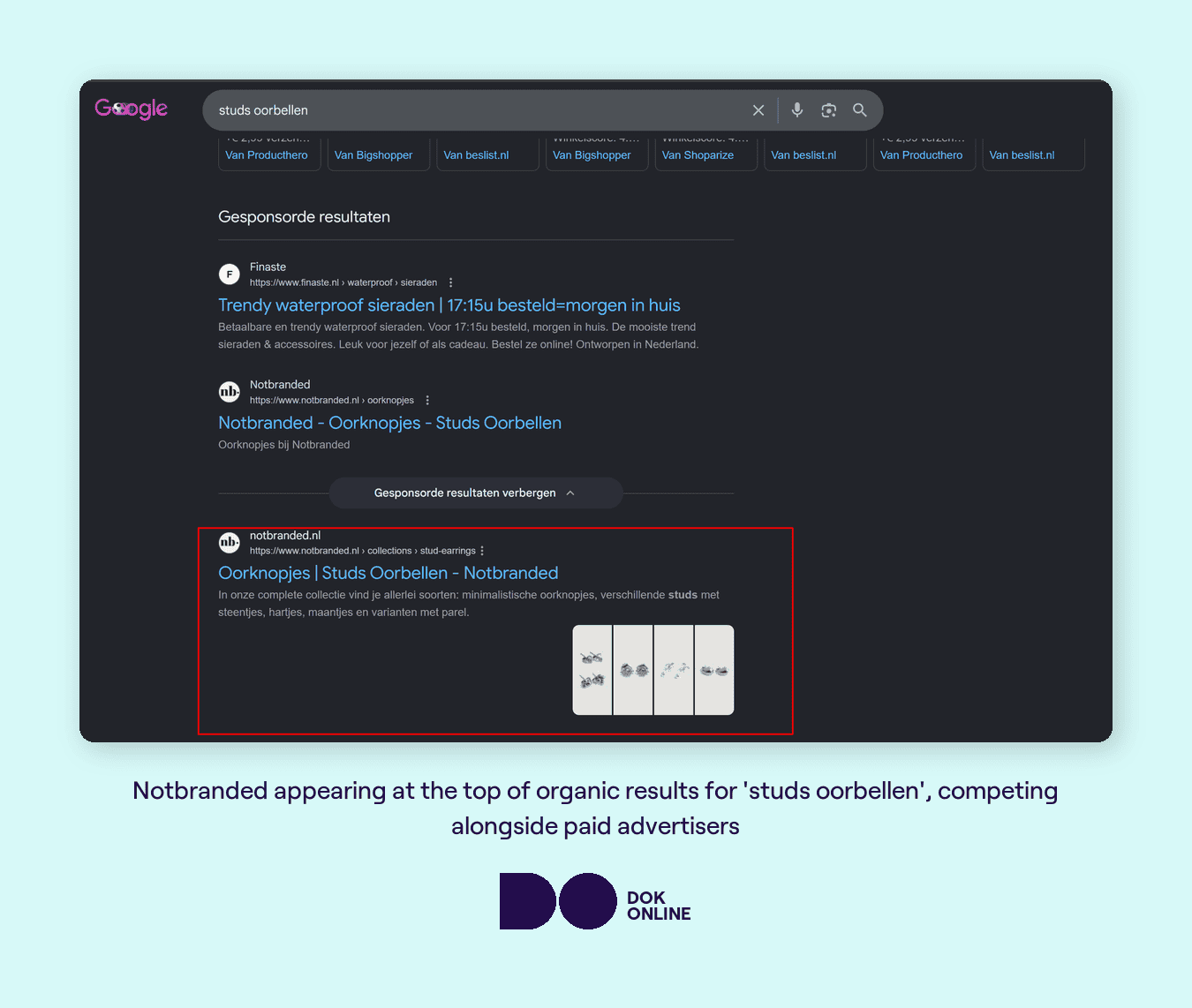
  • “Oorringen” entering the top 10 in Google NL, climbing toward the top 5.
  • Broader keyword coverage across all major jewellery categories, with multiple subcategory pages entering the top 10 for the first time.
  • 80+ collection pages live with SEO-optimised copy, structured around primary keywords and supporting subkeywords.
  • Technical foundation strengthened through regular audits, cleaner indexation, and structured-data fixes across the multistore.
  • Organic search established as a meaningful revenue channel.

Our approach

We built a category-first Shopify SEO system designed to convert Notbranded’s strong brand recognition into broader organic discoverability, one product pillar at a time.

We mapped the full jewellery search landscape for the Dutch market and built a structured content hierarchy across four product pillars: earrings, necklaces, bracelets, and rings. For each pillar we identified parent categories, subcategories by style, material, and colour, and mapped every target keyword to a dedicated Shopify collection URL. The output was a living content workbook per category, updated monthly, that defines what to build, what to optimise, and what is already live. Priority was set by a combination of search volume, commercial potential, current rankings, and product availability.

We wrote and published SEO-optimised copy for 80+ Shopify collection pages, covering subcategories by style (statement, minimalist, pendant, bangle), material (stainless steel, pearl, natural stone), and colour. Each page was built around a primary keyword cluster with supporting terms woven in naturally, written in Notbranded’s warm, direct brand tone to satisfy both user intent and search relevance.

Every collection page was built with a deliberate internal linking strategy: parent categories linking to subcategories, material variants cross-linking to colour variants, and related pillars connecting to each other. This structured linking distributes authority across a site that grew significantly in page count during the campaign, guides crawlers through the full architecture, and strengthens topical relevance for the entire jewellery cluster.

Behind the content, we kept the technical foundation healthy so every new page could be found, crawled, and indexed efficiently. We ran regular technical audits across the Shopify multistore: resolving duplicate content between market variants, tightening crawl directives in robots.txt and meta robots tags, and cleaning up structured data so category pages surfaced correctly in search. This ongoing monitoring meant indexation issues were caught early, and the content programme always built on solid technical ground rather than fighting it.

Content was written to be referenced in AI-generated answers, with factual product descriptions, clear material and USP statements, and copy structured to answer the informational queries that sit alongside commercial intent. As AI-assisted shopping grows, this approach extends organic reach beyond traditional search into tools like ChatGPT, Perplexity, and Google AI Overviews. To scale this across all eight markets without sacrificing quality, we also began piloting an automated content workflow: using AI-assisted production for category and product copy, translations, and internal linking, so the system could expand efficiently while staying on-brand.